Independent product · 2023 to 2024
Balance
A health and wellness app I built to learn iOS, and later learned to critique.
- Role
- Sole designer and developer
- Stack
- SwiftUI, SwiftData, HealthKit, Firebase
- Scope
- Concept, IA, UI, full implementation
- Status
- Complete not released publicly
Read this one differently. Balance was an engineering project. I wanted to learn Swift properly, so the code got the attention and the interface got what was left. I am including it because building it changed how I work, and because the most useful thing I can do with it now is say precisely what is wrong with it.
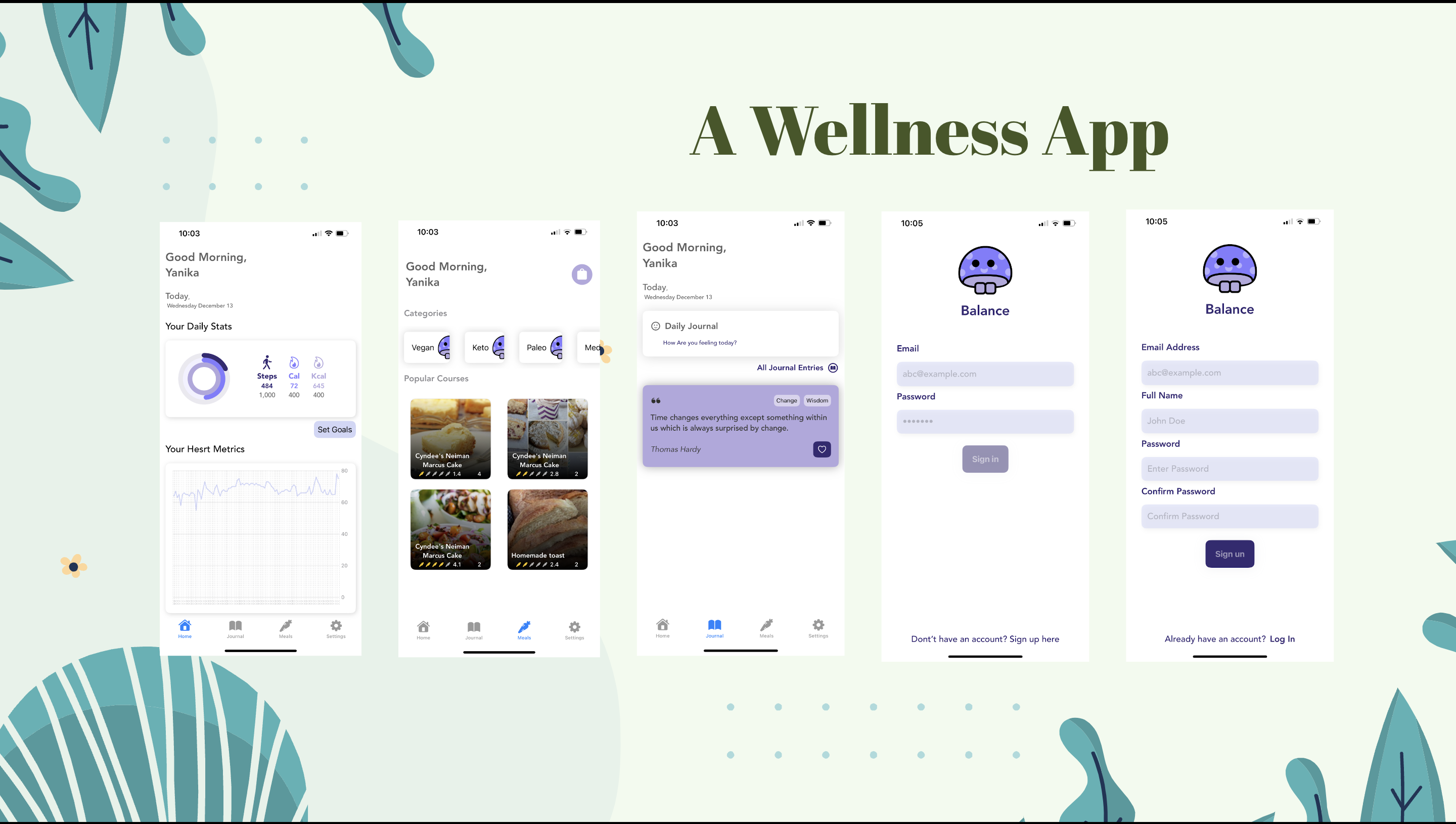
Home, meals, journal, and auth. Built in SwiftUI, 2023.
Four tabs, one question
Most health apps track your body. Journaling apps track your head. Balance was an attempt at holding both, on the theory that the relationship between them is the thing people are actually trying to understand about themselves.
Activity
Calories burned, step count, and heart-rate trends pulled from HealthKit into one view.
Food
Recipe and food search, so meal planning sits next to the activity it is meant to support.
Mood
Daily mood logged with custom emoji, building a visual record over time, plus a daily quote from the Quotable API.
Profile
Login and sign-up through Firebase Auth, with SwiftData handling local persistence.
What I actually learned
The goal
Learn Swift by shipping something real, not by following a tutorial.
Four tabs meant four different problems: HealthKit permissions and queries, a third-party food API, local persistence with SwiftData, and Firebase authentication. Each one forced a different part of the platform. A to-do app would have taught me none of it.
What it changed
I stopped writing specs an engineer has to interpret.
Working solo collapsed the gap between deciding something and living with it. Every ambiguity I would normally have handed off came straight back to me. That is the single biggest reason my handoffs are shorter now, and it is why I can prototype in the real stack instead of describing what the real stack should do.
What I would change, and why
The interface is the weakest part of this project, and I know exactly why. I was optimizing for whether the code worked, and I let the design follow the architecture instead of the other way round. Four years of doing this professionally makes the problems easy to name.
Structure
Four tabs is a bag of features, not a product
Meaning
HealthKit gives you numbers, not understanding
Friction
The most valuable tab has the highest entry cost
Decoration
A daily quote that ignores the day
Why a flawed project is still worth showing
I could have quietly left this one off. I am including it because a portfolio of only polished work tells you nothing about how someone sees, and because the gap between what I built in 2023 and what I would build now is the clearest evidence I have of the distance covered.
Balance is also the reason I describe myself as a designer and a developer rather than a designer who can read code. Owning something from first sketch to shipped SwiftUI view is a different kind of understanding than reviewing a build someone else made.
Next project
Clarix→